
On Frederick Buechner’s 100th birthday, we’re remembering how he mentored so many of us.







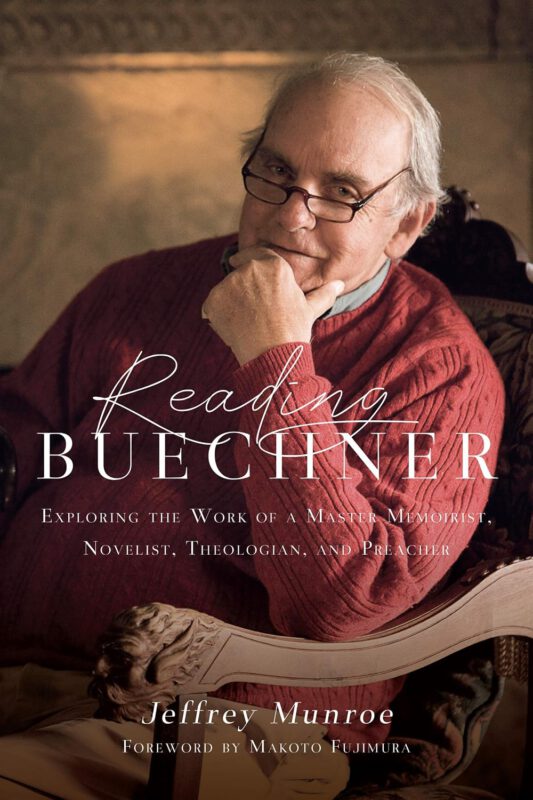
The Mysterious Power of Buechner’s Storytelling Continues Even at His Centennial
Nearly every veteran American religion writer I’ve met over the decades has a Frederick Buechner story to tell—including myself.
I first met Buechner at a conference of journalists, where he appeared just after he had published his 1983 memoir, Now and Then: a memoir of vocation, which astonished me and so many others with lines like these:
Listen to your life. See it for the fathomless mystery that it is. In the boredom and pain of it no less than in the excitement and gladness: touch, taste, smell your way to the holy and hidden heart of it because in the last analysis all moments are key moments, and life itself is grace.
At that point, I was closing in on my first decade as a full-time journalist and those words transformed my understanding of what I felt called to do. Prompted by Buechner, I came to realize that there is, in fact, a sacred vocation of journalism in reporting people’s stories with fairness, accuracy and balance—from the shortest news story to the longest magazine profile. This commitment to fairness, accuracy and balance is more than a secular journalistic “code”—it is a discipline calling reporters and editors to share with clarity the unique nature of each life we encounter.
I became a life-long reader of everything Buechner wrote. As a journalist, I also had the pleasure of occasionally interviewing him through the decades.
And, while the release of Now and Then and that first encounter with him in person at a conference stirred deep reflections—it was my second personal encounter with Buechner that truly changed my life. In May 1989, I spent a weekend with him when he came to Ann Arbor’s First United Methodist Church to deliver the endowed Loud Lecture for the Wesley Foundation campus ministry based at that church. I will never forget how anyone who knew Buechner’s work made sure to attend every public event at which he was speaking—including, not just one, but both of the Sunday worship services at which he preached. While the vast majority of preachers with two Sunday morning services deliver the same sermon twice—Buechner brought two complete messages that built upon each other—and related to the even-more-lengthy Loud Lecture itself. He was delivering an entire body of work that weekend.
I can still close my eyes and remember the slow, measured cadence of his elegantly reedy voice as he delivered astonishing little stories—then wove them together with short teachings that I could tell were striking at the heart of my own profession.
And, this week, as we reach the centennial of his birth, I’m especially pleased to recall that particular Buechner appearance in Ann Arbor, on the doorstep of the University of Michigan, in 1989. He lived 96 years from July 11, 1926, to August 15, 2022. Anyone who has followed his remarkable life’s work might assume that his seemingly endless tidal wave of essays, books (both fiction and nonfiction), sermons and other meditations are somewhere all preserved for the future.
But they’re not.
Those three life-changing messages Buechner delivered in Ann Arbor on May 12, 1989, do not seem to exist in any accessible form, today. The texts may exist in paper form somewhere deep in his archives. I assume that’s the case because he liked to write out drafts of his messages, but then I know that he also departed from his written text in those Ann Arbor talks. So, it’s likely there are paper drafts in an acid-free box somewhere. But there are no online versions of those actual 1989 talks. That means those weekend encounters with Buechner are now ephemeral—mysterious because they were so profound and yet have all but vanished from the historical record. As a journalist still working every day in 2026, I’m stunned to think that those talks that shifted the core vocation and direction of my life may only exist in the memories—and the lives—of those who were there in Ann Arbor that weekend. Nobody thought to properly archive them.
I’m angry! How could that happen? How could the Loud committee not have preserved those talks so we could have online access today?
But then—then, I smile as I ponder this.
Finally, I begin to chuckle as I envision Buechner himself laughing at what I’ve just written.
Why? Because that’s exactly the point Buechner made that weekend: Our stories hold the potential to transform our lives and our world if only we remember them truly and retell them accurately.
Buechner had no idea whose lives he might touch that weekend. He simply brought three messages and “spoke” them into the world. And many came to hear. I was there. I listened. I remembered. And his messages shaped thousands of other stories I have reported or edited since that time.
Who knows who else Buechner touched in the crowds that weekend in Ann Arbor—or in his hundreds of other public appearances throughout his life?
As you read this, are you one of “us”?
And that little story is my contribution to this “Centennial” series of Buechner columns—just as my friend and colleague Jeffrey Munroe urged me to do.
Jeff told me: “In your Monday issue, tell a little of your own story with Buechner—and then link to mine.”
So, now, I’m going to urge you to read further—both Jeff’s column and another by our mutual friend Douglas J. Brouwer.
Explore how Buechner influenced authors, journalists, pastors and their congregations
IN HIS OWN REMEMBRANCE OF BUECHNER THIS WEEK, author and Editor of The Reformed Journal Jeffrey Munroe writes a column that he headlines: How to Honor Frederick Buechner at 100. We don’t think it’s a “spoiler” to tell you that Jeff’s main suggestion is: Honor him by reading one of his novels. Why the novels? Well, click on his headline-link and Jeff will explain.
BUECHNER’S INFLUENCE KEPT SPREADING BY “WORD OF MOUTH” through the decades that he was most active. Pastors quoted him in Sunday sermons. Friends recommended him to others. Newspapers and magazines cited him. For a while, there was even a daily calendar featuring inspiring Buechner quotes that thousands of his readers displayed in their homes and offices. There’s also a book form of that calendar.
A good example of that amplification is shared in Douglas Brouwer’s Buechner Centennial column, this week, titled: Reading Godric, Finally—In which I complete a friend’s challenge, admire a masterpiece, and confess which Buechner I love best. In that column, Doug also completes the circle of this column by mentioning Jeffrey Munroe’s influence. In addition to heading the Reformed Journal online magazine, Jeff is the founding Editor of Reformed Journal Books, the publishing house behind Doug’s award-winning The Traveler’s Path, a 2025 memoir that clearly has a touch of Buechner’s influence in its pages.
AND, TO EXPLORE ANOTHER “TURN” OF THIS CREATIVE CIRCLE, check out Jeffrey Munroe’s own memoir, Telling Stories in the Dark, which also is unmistakably intertwined with Buechner’s legacy.