
Hoping for peace? Pew Research shows us that, first, we need to understand the world’s religious diversity.







EDITOR’s NOTE: A “Part 2” to this story was published February 23, 2026, exploring further studies of our religious landscape.
From the fury in American politics to the tragic patterns of global refugees and warfare—any hope for achieving peace rests on understanding our religious diversity. That’s why our publishing house has specialized in exploring religious and cultural diversity over the past two decades.
Religion is a pillar of global cultures and our personal identities.
However, that truth was questioned a decade ago, when headlines were proclaiming that religion may be fading as a factor in public life. That speculation was fueled by the growing number of Americans—surpassing 1 in 4 of us—who were declining to identify a religious affiliation for pollsters. Because polls are designed to “sort” people with traditional labels, pollsters were frustrated that they couldn’t categorize this growing number of people whose spiritual lives didn’t fit their longstanding labels. Researchers started calling this quarter of the population “the nones,” because they would not choose one of the long-standing religious affiliations.
The “Rise of the Nones” led media professionals and scholars to speculate: Perhaps global culture was producing a new secular age in which religion was losing its potency?
Well, hardly!
And now Pew Research is reporting both that the drift toward disaffiliation is over—and that a powerful mix of religious communities around the world is a vital influence in contemporary life.
This week, I’m writing this column to help readers “see for yourselves” what Pew is reporting.
Pew is offering 100s of pages of research reports. So, where should we begin?
Let’s start with Pew’s news that the ‘Nones’ group isn’t growing
Last year’s major report from Pew began with these words:
After many years of steady decline, the share of Americans who identify as Christians shows signs of leveling off—at least temporarily—at slightly above six-in-ten, according to a massive new Pew Research Center survey of 36,908 U.S. adults.
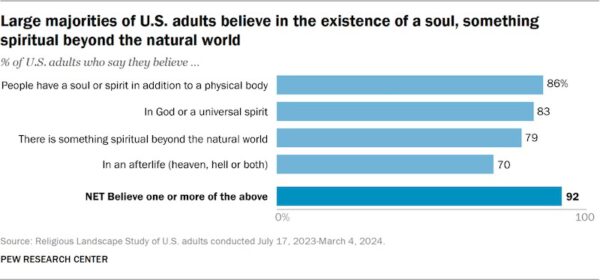
In fact, Pew researchers reported, the vast majority of Americans—even many so-called “Nones”—have rich spiritual lives. Pew had to use new kinds of charts (like the one below) to illustrate new ways of describing our religious life.
This landmark report is packed with fascinating information. You can read the entire report yourself. Here’s a link to download that entire 393-page report in PDF format.
Then, in mid-February 2026, Pew published a worldwide snapshot of our religious diversity.
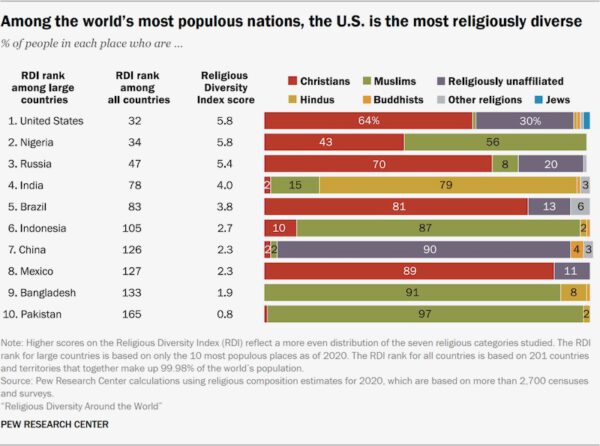
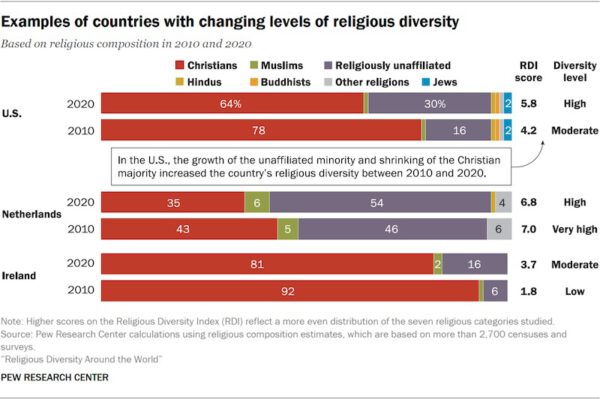
First, Pew reported that the United States had become more religiously diverse since 2010—which may explain a lot about the rising level of friction between religious groups within the U.S.
And, second, Pew reported that there are dozens of other countries around the world that are, right now, more religiously diverse than the United States. This suggests that peace may be possible even in countries with wide differences in religious practice. Perhaps we need to be spending more time exploring the religious diversity in countries around the world.
One key conclusion from this new February 2026 report says:
The United States is not among the 10 most religiously diverse countries in the world (it ranks 32nd overall). But when looking just at the 10 most populous nations, the U.S. ranks first in religious diversity, followed by Nigeria, Russia, India and Brazil. This analysis divides the world’s population into seven categories—Christians, Muslims, Hindus, Buddhists, Jews, adherents of all other religions and people with no religious affiliation—and measures how evenly these groups are represented within each country or territory.
Yes, indeed, there is a whole lot to think about in these reports!
And, here’s a link to download the entire 27-page report Pew published on February 12, 2026.
Our commitment as a publishing house remains unchanged.
When we began publishing nearly two decades ago, on our very first day in fact, we published our 10 Principles of Publishing, which we include in our “About” page now. Several of those 10 principles are especially relevant here:
- We must look for the truth in every stage and condition of life—because we often overlook the voices of the most vulnerable among us.
- It’s about connection, not competition. Our messages should call people together, not divide them.
- Inspiration moves through community. It’s been true for thousands of years. Good media builds healthier communities.
- Peace is possible. Choose to contribute to peace, not conflict, and our audience will grow.
One way to “see” our overall commitment, at a glance, is to look through the two dozen books we have produced over the years with the Michigan State University School of Journalism Bias Busters project.