Our new book about U.S. Catholics is as timely as daily headlines







After nearly two decades of working with Front Edge Publishing, one of the core values I appreciate as a journalist is the timeliness and relevance of Front Edge’s schedule of new books. In fact, that’s why I forged a unique partnership between the Michigan State University School of Journalism and the publishing house to launch an award-winning series that now includes two dozen volumes from our “Bias Busters” project.
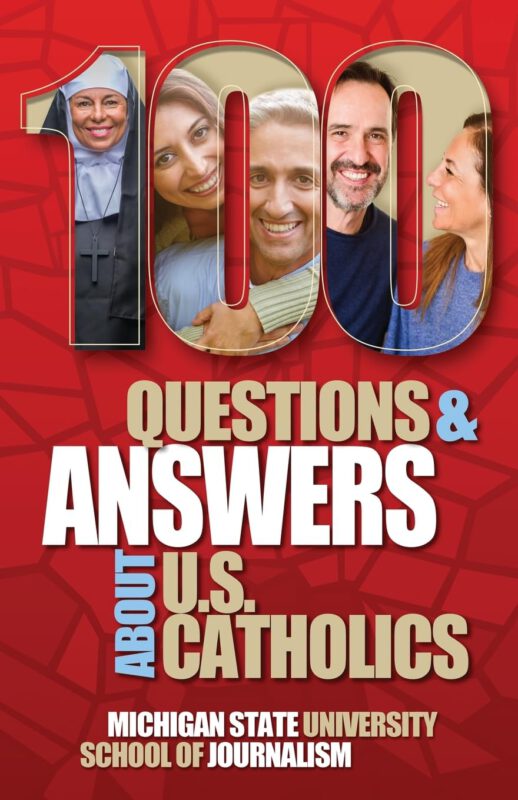
In this newsy column, I want to illustrate just how timely our book 100 Questions & Answers about U.S. Catholics has been since it was released on June 24, 2025.
Consider these milestones that prompted Americans to ask lots of questions about Catholics:
In early 2025, President Donald J. Trump’s support among U.S. Catholics was rock solid. But now—in January 2026 with midterm elections on the horizon—cracks appear to be developing.
So, let’s look back to April 21, 2025, the day Pope Francis died. That’s when the Associated Press asked Trump on camera about his message to U.S. Catholics. He said, “We love you all. We’re with you all. They were with me during the election—as you know, very strongly—and it’s such an honor to have the support of the Catholics.” Trump said he expected to have good relations with the new pope.
On May 8 when the College of Cardinals elected Pope Leo XIV, the first American pope in history, some could foresee a stronger bond between Vatican City and Washington, D.C.
Then, on Nov. 11, 2025, observers thought there might be further alignment when the conservative-leaning Archbishop Paul S. Coakley of Oklahoma City was elected president of the U.S. Council of Catholic Bishops. However, Coakley’s win was a narrow one on the third ballot.
The next day, the bishops issued a rare statement opposing “the indiscriminate mass deportation of people.” They called for an end to “dehumanizing rhetoric and violence, whether directed at immigrant or at law enforcement.” It was the first such “special pastoral message” since 2013 when the conference addressed the Obama administration’s contraceptive mandate.
Apparently, Catholic support for Trump had its limits. Michael J. O’Loughlin, executive editor of the National Catholic Reporter, wrote that we are seeing a “seemingly widening gap between U.S. bishops and Trump, who heavily courted and won over U.S. Catholics during his 2024 campaign.”
O’Loughlin saw the cracks opening up. On Jan. 3, the U.S., which had been building up its military assets near Venezuela, captured its president, Nicolás Maduro and his wife, transporting them to a New York City jail. Trump said the United States would run Venezuela. On Jan. 5, White House Deputy Chief of Staff Stephen Miller stirred the simmering Greenland pot by saying the United States would acquire it. Miller told CNN’s Jake Tapper, “We live in a world in which you can talk all you want about international niceties and everything else, but we live in a world, in the real world … that is governed by strength, that is governed by force, that is governed by power.” In a Jan. 8 Oval Office interview with The New York Times, Trump discussed his desire to make Greenland part of the United States, Trump said, “I don’t need international law, I’m not looking to hurt people.” He said the only check on his power is his “own morality, my own mind. It’s the only thing that can stop me.” In response to a question about whether he believes in international law he said, “I do,” but qualified, “it depends on what your definition of international law is.”
The morning after The Times interview, Pope Leo XIV used English to deliver part of his address to ambassadors assigned to the Holy See. He seemed to be referencing Trump, though he did not mention him. Leo objected that “peace sought through weapons as a condition for asserting one’s own dominion. This gravely threatens the rule of law, which is the foundation of all peaceful civil coexistence.” Leo said, “The principle established after the Second World War, which prohibited nations from using force to violate the borders of others, has been completely undermined.”
Then, two presidents, Trump and Archbishop Coakley, met in a closed-door meeting at the White House on Jan. 12. The Roman Catholic Archdiocese of Washington, D.C.’s newspaper the Catholic Standard floated that they might have talked about immigration, the death penalty and gender policy. More likely, they talked about the White House’s relaxation of visa requirements on foreign-born religious workers. The USCCB thanked the White House for that on Jan. 14.
The next words out of the council of bishops were not conciliatory. On a military front, Archbishop Timothy Broglio, head of the Archdiocese for Military Services, said on Jan. 18 that any U.S. invasion of Greenland would likely be morally unjust and that service members could conscientiously refuse such commands. This mirrored similar statements for which the Trump administration is trying to punish members of Congress.
On Jan. 19, the three U.S. cardinal archbishops, who had just met with the Pope Leo at the Vatican, backed him up and pushed back on Trump’s statement about personal morality. The three, described as progressives, echoed The Times interview, warning that without a moral vision, U.S. foreign policy would fall into “polarization, partisanship, and narrow economic and social interests.”
“Most of the United States and the world are adrift morally in terms of foreign policy,” Cardinal Robert McElroy, archbishop of Washington, D.C., told The Associated Press, “I still believe the United States has a tremendous impact upon the world.”
Will tension between the church and the president move Catholic voters in the mid-term elections and beyond?
Will Trump respond?
How will the council of bishops resolve its differences?
It is too early to tell. Catholic voters are an important voting bloc, but they are not monolithic, and this story is still being written.
However, I am proud to see the MSU School of Journalism providing one of the most timely books that explains American Catholic life, faith, culture and traditions. We’re always trying to answer the questions “real people” are asking, each day, as they gather to talk with family, friends and co-workers.
Read about U.S. Catholics, their beliefs, politic and differences in “100 Questions and Answers About U.S. Catholics: Pope Francis, his Legacy and the Transition to Pope Leo XIV.” This and more than 20 other guides are on Amazon.