
Who speaks for the more than 50 million American Catholics? We’re publishing books that explain this red-hot question








Competing Catholic Voices: From the Clarity of the Vatican to the Muddy Back Waters of American Politics
By JOE GRIMM
Founder of Michigan State University School of Journalism’s Bias Busters project
The Roman Catholic church is the largest religious denomination in the world.
Period.
With nearly 1.4 billion people around the world and one quarter of all Americans counted as Catholics by Pew Research, the red-hot political question for many years has been: Who speaks for this vast number people?
That is one of 100 Questions and Answers about American Catholics—coming soon in our ever-expanding Bias Busters book series.
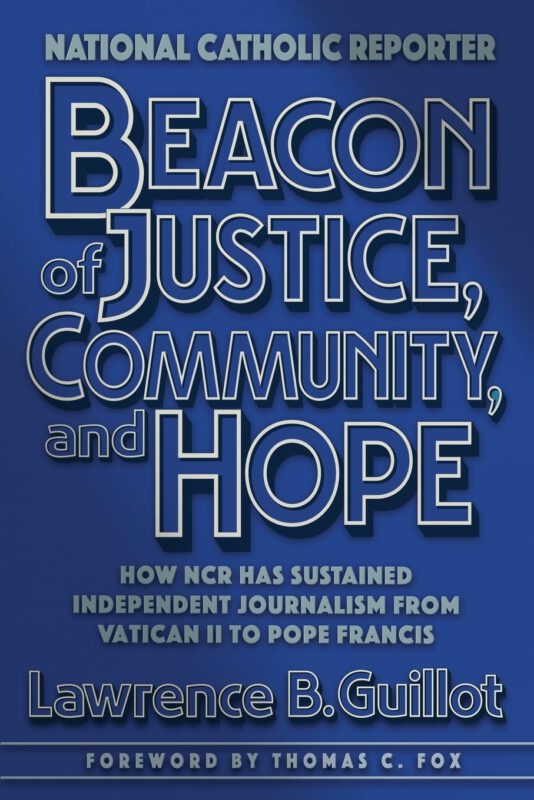
And it’s a central theme of our publishing house’s recently released book: National Catholic Reporter—Beacon of Justice, Community and Hope.
The problem is: Everybody seems to want to speak for the church—as evidenced in two developments thousands of miles apart.
In one, the worldwide church’s central leader—Pope Francis—tried to call on all Catholics to show compassion in today’s overly competitive world.
In the other example, American-style political mud-slingers in the central United States tried to dupe Catholics with the widespread distribution of a fake newspaper.
First, Pope Francis’s Message
The irony in this news cycle is that the pontiff warned Catholics around the world that they are losing their God-given sense of compassion—”the importance of the heart”—in today’s culture of vicious competition. Of course, that’s only a summary. The encyclical is 65 pages long in its English PDF, which is posted for anyone to download on the Vatican website.
One of the ways the Pope described the central problem he was trying to address was: “Indeed, the men and women of our time often find themselves confused and torn apart, almost bereft of an inner principle that can create unity and harmony in their lives and actions.”
(For an American analysis of the new encyclical, check out this New York Times overview.)
Second, Catholic-themed political mud slinging
As if illustrating Pope Francis’s timely warning—Roman Catholic archdioceses in several swing states have issued warnings about partisan mailed newspapers that appear to be from the church—but aren’t. The newspapers are “pink slime” fakes.
In Grand Rapids, Michigan, WOOD-TV reported, “The 12-page newspaper is filled with opinion pieces against Democrats, presidential candidate Kamala Harris, transgender athletes, abortion and illegal immigration.” Annalise Laumeyer, director of communications for the Diocese of Grand Rapids, told WZZM-TV, “What concerns us is that the headline is the Michigan Catholic Tribune, making it seem like it is a publication of the Diocese of Grand Rapids and of the Catholic Church, which is not the case. We do not endorse and are not affiliated with the Michigan Catholic Tribune or any of its content inside.”
That phrase “pink slime” comes from a description of the filler used to bulk up the size and weight of processed meat. The phrase now refers to products that are marketed under false pretenses. In this case, church officials condemned these mailings because they were spreading falsehoods while copying the look and feel of real newspapers that are sponsored by Catholic organizations.
The Milwaukee Journal Sentinel reported that officials in several Wisconsin dioceses also have publicly declared that they have no association with the mailers. Madison Bishop Donald Hying issued a statement saying, “This direct-mail piece, which is political in nature, is not a publication from the Church in Madison or Wisconsin, and the publishers do not have permission in the Diocese of Madison to present their content as Catholic.”
The Catholic News Agency wrote “the papers have also shown up recently in mailboxes in Iowa, Pennsylvania, and Nevada.”
So, who is behind the masquerade? An investigation by the nonprofit newsroom Pro Publica traced the mailings to a Chicago-based network led by former TV reporter Brian Timpone. “His enterprises, including Metric Media, are known among researchers for peddling misinformation and slanted coverage,” Pro Publica wrote. “The network has received money from right-wing super PACs funded by conservative billionaire Richard Uihlein.”
Pro Publica found that “Similar papers were mailed to swing-state residents ahead of the 2020 and 2022 election cycles. … There are Catholic Tribune websites registered for all 50 states, plus one national version, but most don’t appear to have published anything for months, if ever.”
The mailings mislead Catholics and non-Catholics alike. Tax-exempt churches are forbidden by the federal Johnson Amendment from this kind of politicking. The Catholic Church takes that prohibition and appearances to the contrary seriously.
In June, the United States Catholic Conference of Bishops reaffirmed its position in its Political Activity and Lobby Guidelines for Catholic Organizations. They say the tax code stipulates that the church “may not ‘participate in, or intervene in (including the publishing or distributing of statements), any political campaign on behalf of (or in opposition to) any candidate for public office.’”
The bishops’ guidelines say, “The IRS interprets the political campaign intervention prohibition as absolute, meaning that a single act can cause an organization to lose its tax exemption.”
Care to read more?
Get a copy of the new National Catholic Reporter—Beacon of Justice, Community and Hope to read about the most important group of independent journalists—the staff of NCR—who have tried to report accurately and fairly on the Catholic Church since the Second Vatican Council.
And please stay tuned to our Bias Busters page on Amazon for news about our upcoming 100 Question and Answer books in this widely acclaimed series.