
Enjoying what Douglas Brouwer wrote in ‘The Traveler’s Path’? Then, don’t miss this addendum.







Yes, here’s one more chapter for world travelers!
Let’s call it—
‘Haircut Tourism’
 No one really knows a country until one has been inside its hair salons
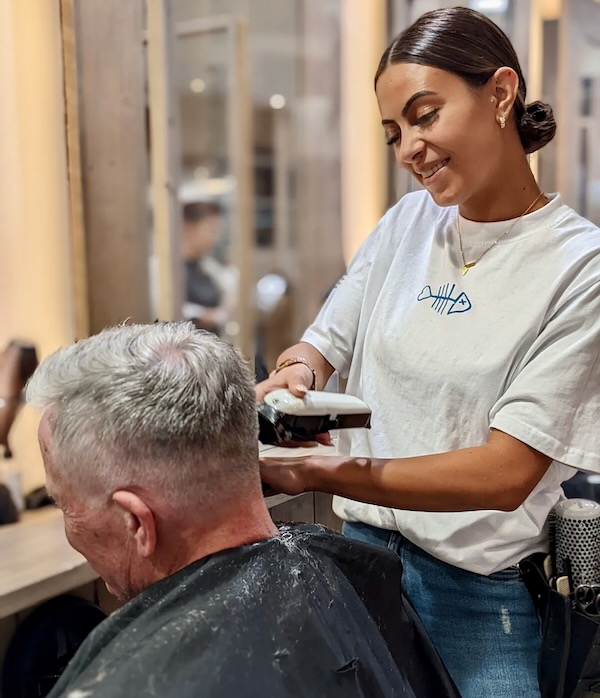 No one really knows a country until one has been inside its hair salons
EDITOR’S NOTE: Any author who has met with our publishing house staff has heard our almost weekly cheerleading: Please, keep writing! We specialize in publishing authors who feel passionately enough about their vocation that they want to play a role in what we often refer to as “the national conversation.” And the only way to do that is: Keep writing! That’s what Douglas Brouwer has done here—and, much to our surprise—hey, we agree with him: This could have been a great chapter in his book. (Who knows? Maybe in a second edition?) But, for this week, the point is: If writers want to make a difference in our world—writers need to write. Take a page from Doug’s ongoing storytelling!
‘Haircut Tourism’
By DOUGLAS J. BROUWER
Author of The Traveler’s Path
I’m not sure how it happened, but I forgot an important chapter in my new book about travel. Here’s the story: I have now had haircuts on four continents.
Travel for me, apparently, is not complete unless I get a haircut in another culture and, importantly, get to know my barber or stylist.
The Traveler’s Path, my latest book, contains a great deal about art, as you might expect, but I also wrote about prisons, a subject you won’t find in most travel books. I have visited prisons on four continents, too. The epigraph to that chapter on prisons was from Nelson Mandela’s memoir, Long Walk to Freedom:
No one truly knows a nation—until one has been inside its jails.
I visited the jail cell on Robben Island where Mandela spent 18 of the 27 years he was incarcerated, and that prison, I must say, told me a great deal about South Africa and its recent history.
The lowly haircut
But the subject I somehow neglected was the lowly haircut, an important window into another culture, if there ever was one. When I lived for several years in a small village near Zürich, Switzerland, I went to a hair salon within walking distance of my apartment building, and the person who cut my hair was a recent immigrant from eastern Europe. As I was to learn about many of my neighbors, she not only spoke the language of her native country (Serbian, I think), but German, Swiss German, and English.
Once, after I had attended language school for a few months—and perhaps thinking that I might like to practice my German—she asked me, “Which language would you like me to speak today?”
Believe me, no American barber has ever asked me that question. Some years later, when I lived for nine months in The Hague, I found a barbershop (or “kapsalon”) in my neighborhood. The young woman who cut my hair was from Egypt, as were her parents, the owners of the salon. As I soon learned, she spoke Arabic, French, English, and of course Dutch. The English she spoke with me, I soon realized, would have put most Americans to shame.
I found myself trying to speak my native tongue much better than I usually do.
When I went to church the following Sunday, several people commented on my new haircut. “Why did you get it cut so short?” was the most frequent comment. And from this I learned very quickly to recognize what is widely known as “Dutch directness.”
The Dutch can be, and usually are, blunt about everything. If they think it, they will more than likely say it. An insight I gained because of—that’s right!—my first Dutch haircut.
The “cutthroat barber” in Marrakech
During the month after I retired, my wife and I traveled throughout Morocco. One day, I Googled “unusual things to do in Marrakech.” In addition to cooking classes and hot air balloon rides, I discovered that getting a straight razor shave was actually quite a popular thing to do.
When I found the closest barbershop, however, I was concerned that the barber advertised his service as a “cutthroat wet shave.” Which might have scared away the average tourist, the mere day tripper, but not a grizzled veteran traveler like me. I even made a YouTube video of the experience.
To be honest, I have since discovered that “haircut tourism” was not something I invented.
As with most travel experiences, someone has done it (or thought about doing it) long before you do it. Perhaps the most famous example of “haircut tourism” is Haircut Harry, whose haircuts on YouTube have received more than 240 million views. Harry seems to have had a straight razor shave at the same Marrakech barbershop where I stopped during my visit.
Blending in, responsible tourism
Wherever I have traveled (or lived for an extended period), I have done my best to blend in. This is obviously easier for me to do in northern European countries than in places like the Philippines, but paying attention to one’s clothing (and hairstyles) is one way to practice responsible tourism.
But here’s the thing:
Not even a local haircut can disguise the fact that I am an American.
I am happy to report, though, that every encounter I’ve had with a barber or stylist has been a memorable one.
(This story originally was published in Douglas J. Brouwer’s Substack column.)
Care to read more?
Get Doug’s book—
And, meet Doug (and our mutual friend Christy) over at Substack
Two of our most popular authors and columnists—both represented in the new Reformed Journal Books series curated by Editor Jeffrey Munroe—provide frequent doses of joy and inspiration over at Substack. If you’re feeling anxious about our troubled world, take a moment right now to visit them and sign up for their future columns. Substack does ask visitors if they want to pay for the service, but here’s more good news: Both Christy and Doug provide all of their offerings for free—so it won’t cost you a cent.
CHRISTY’S LATEST on Substack is headlined Mutualism in the Natural World.
DOUG’S LATEST, before this column about haircuts, is headlined I’ve never done it before, but—
AND THE REFORMED JOURNAL ITSELF is also well worth a couple of clicks of your mouse to subscribe to its free columns, coordinated by Jeffrey Munroe and his editing team. We all can use a little “good news” in our inboxes each morning and these three—Christy, Doug and Jeff—are among the best writers and editors we know who reliably deliver often-surprising rays of light and paths toward resilience.